


In an interview granted this Sunday to Spanish daily La Razón, the new Prefect of Divine Worship, Cardinal Cañizares Llovera, had this to say on an important liturgical matter:
[La Razón:] Nevertheless, Benedict XVI has reiterated in some instances the propriety of receiving communion kneeling and in the mouth. Is it something important, or is it a mere matter of form?
[Cañizares:] - No, it is not just a matter of form. What does it mean to receive communion in the mouth? What does it mean to kneel before the Most Holy Sacrament? What dies it mean to kneel during the consecration at Mass? It means adoration, it means recognizing the real presence of Jesus Christ in the Eucharist; it means respect and an attitude of faith of a man who prostrates before God because he knows that everything comes from Him, and we feel speechless, dumbfounded, before the wondrousness, his goodness, and his mercy. That is why it is not the same to place the hand, and to receive communion in any fashion, than doing it in a respectful way; it is not the same to receive communion kneeling or standing up, because all these signs indicate a profound meaning. What we have to grasp is that profound attitude of the man who prostrates himself before God, and that is what the Pope wants.
Canonistic Notes on Summorum Pontificum
by Gregor Kollmorgen
The first 2008 issue of Liturgisches Jahrbuch ("Liturgical Yearbook") contains some very clear and sound notes from a canonist's perspective on the implications of Summorum Pontificum. This is all the more surprising and gratifying as Liturgisches Jahrbuch is a quarterly edited by the German Liturgical Institute (Deutsches Liturgisches Institut), the centre of German liturgical "officialdom" maintained by the German Bishops' Conference. The article (Liturgisches Jahrbuch 1/2008, p. 3 ff.) is written by Prof. Norbert Lüdecke who teaches Canon Law at the University of Bonn. A summary of the article is given in the current issue of Una Voce Korrespondenz, the quarterly of the German Una Voce association (4/2008, p. 371 ff.), of which a summary appeared, on December 1st, 2008, on the website kath-info.de, which we present to you here in an NLM translation:
1. The bishops may issue "annotations and instructions for the implementation" of the motu proprio Summorum Pontificum, but they may not add "new mandatory content" (cf. the analysis of the "guidelines" of the German Bishops' Conference by Prof. Georg Muschalek).
2. The "guidelines" of the German Bishops' Conference of 27 September 2007 are not binding upon the individual diocesan bishop.
3. The celebration of the Missa sine populo is, except in the case of insurmountable obstacles, to be allowed "at any legitimate place". "Restrictions of the usus antiquior to certain places or times by particular law are (...) inadmissible."
4. In a Missa sine populo (literally translated: "Mass without people") the faithful may participate sua sponte (i.e. without compulsion). They may also advert other faithful to this Holy Mass.
5. For a group, which according to the Motu proprio is a prerequisite for the celebration of a Holy Mass with the people, the number of three persons is sufficient. The diocesan bishop cannot establish a higher minimum number.
6. The parish priest must not discriminate against Masses according to the old use "by keeping them secret or scheduling them at times difficultly accessible".
7. "The Pope has not ordered that the parish priest could meet the request of interested faithful. He has mandated that the parish priest must do so"(Lüdecke).
8. Faithful whose right to Holy Mass in the older use is being denied by the parish priest do not only have the possibility, but the duty to inform the diocesan bishop about this.
9. "Applications" for the traditional liturgy are "not petitions of grace or favour." "Parish priests as well as diocesan bishops are legally held to meet this request" (Lüdecke).
10. The consent of the bishop to a Holy Mass according to the old use instituted by a parish priest according to the desire of faithful is not required.
11. Laypeople as extraordinary ministers of Holy Communion and women as altar servers are not allowed in the traditional liturgy.


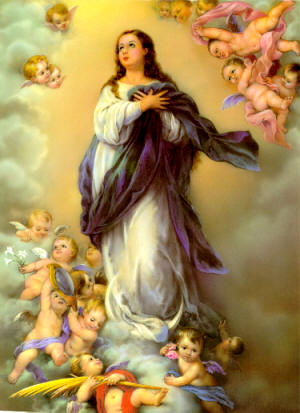 Novena Conceptionis Immaculatae BM Virginis


 Today, on Sunday, Fr. Durham celebrated a sung Mass at Saint Henry's Cathedral, Helsinki, Finland. The Mass was followed by a church coffee and a long but interesting conference on the development of the liturgical books in the Roman Rite.


 Äiti Teresan sisaret ottavat meidät aina yhtä iloisesti vastaan. Keskustelu kävi eksorkismeista Kristuksen kuninkuuteen ja kaiken kruunasi vaikuttava, hiljainen messu. Tästä se taas alkoi:


"With Communion in the hand, a miracle would be required during each distribution of Communion to avoid some Particles from falling to the ground or remaining in the hand of the faithful.... Let us speak clearly: whoever receives Communion in the mouth not only follows exactly the tradition handed down but also the wish expressed by the last Popes and thus avoids placing himself in the occasion of committing a sin by negligently dropping a fragment of the Body of Christ.”
... I once interviewed the Patriarch of Antioch, in Damascus. I asked His Beatitude whether he, like the Bishop of Rome, believed he had power radically to alter the liturgy. "Oh yes, we have authority in liturgical matters. And in 1,500 years we did once alter a prayer."
Clearly the idea of virtually inventing a new rite had never entered the Patriarch’s head. (The so-called "Tridentine’’ rite was not invented by the Council of Trent, but was a codification of the Roman rite which dated back many centuries.) The question all along was whether pope and bishops really do have such authority. One distinguished Catholic thinker judged that there was no such sweeping power, that liturgy had its own authority based on immemorial tradition, and that the pope’s authority in liturgy "is at the service of Sacred Tradition." The same thinker even dared to describe the new mass as "no re-animation but devastation… fabricated liturgy… banal-on-the-spot product." The man who wrote those words is now Pope Benedict XVI. The Cardinals elected Ratzinger knowing that these were his convictions. It cannot have been done in a fit of absence of mind.
...
Something unexpected seems now to be happening in the Catholic Church. Far from attachment to the old forms dying away, a generation of younger priests and lay Catholics is coming into view that is enthusiastically attached to the Tridentine mass, and to Catholic orthodoxy. In France, one in five of all priests currently being ordained is devoted to the old mass. And this is a committed, determined minority growing up in a virtual wasteland for the French Church. Only five per cent of French Catholics attend mass regularly. In one diocese, the Cathedral attracts seventy worshippers on Sunday, while the chapel of semi-schismatic Society of St Pius X (of Archbishop Lefebvre) attracts seven hundred to a traditional mass. Indeed, it is suggested that an actual majority of church goers on a Sunday in France attend Lefebvrist services. ...
Pope Benedict XVI made a low profile but significant move in the direction of liturgical reform by completely renewing the roster of his liturgical advisors yesterday. ... The new consultants include Monsignor Nicola Bux, professor at the Theological Faculty of Puglia (Southern Italy,) and author of several books on liturgy, especially on the Eucharist. Bux recently finish a new book "Pope Benedict’s Reform," printed by the Italian publishing house Piemme, scheduled to hit the shelves in December.
The list of news consultants includes Fr. Mauro Gagliardi, an expert in Dogmatic theology and professor at the Legionaries of Christ's Pontifical Athenaeum “Regina Apostolorum”; Opus Dei Spanish priest Juan José Silvestre Valor, professor at the Pontifical University of Santa Croce in Rome; Fr. Uwe Michael Lang, C.O., an official of the Congregation for the Divine Worship and the Discipline of the Sacraments and author of the book "Turning Towards the Lord" -about the importance of facing "ad orientem" during Mass; and Fr. Paul C.F. Gunter, a Benedictine professor at the Pontifical Athenaeum Sant Anselmo in Rome and member of the editorial board of the forthcoming "Usus Antiquior," a quarterly journal dedicated to the Liturgy under the auspices of the Society of St. Catherine of Siena. The Society, which has an association with the English Province of the Order of Preachers (Dominicans), promotes the intellectual and liturgical renewal of the Church.


 Pyhän ruusukon kuningatar, uudistan nyt vihkiytymiseni sinulle ja tahrattomalle sydämellesi. Rakas äiti, hyväksy minut ja käytä minua niin kuin tahdot, jotta sinun suunnitelmasi toteutuisivat maailmassa. Äitini ja kuningattareni, olen kokonaan sinun, ja sinulle kuuluu kaikki, mitä omistan. Aamen.


 Tekstit

